

3 Types of Common Cataract Surgery: Choose the Right One
December 24, 2025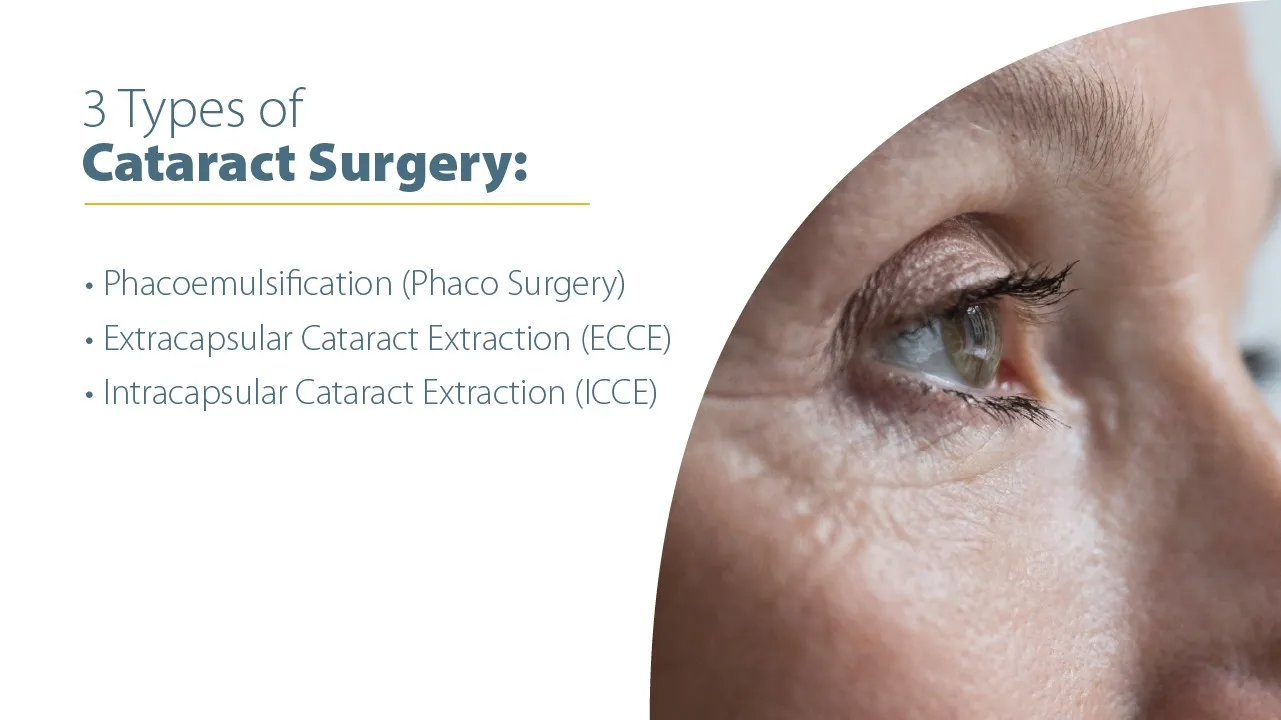
Millions of people, primarily older adults, face vision loss from cataracts every year. This occurs when the eye's lens clouds, leading to light sensitivity and difficulty seeing clearly. The only proven way to restore vision is with surgery. Today's options are quicker and safer than ever before.
In this guide, we will break down the three most common and advanced eye surgery procedures available. Beyond curing the cloudiness, you will learn how cataract surgery significantly improves contrast and quality of life.
What is Cataract Surgery?
Cataract surgery is a medical procedure in which the cloudy natural lens of the eye (the cataract) is removed and replaced with an artificial intraocular lens (IOL). This procedure transforms the eye's function, essentially curing the cataract. The primary cataract surgery benefits include significantly improved vision clarity, better contrast sensitivity, and a reduction in glare.
Modern advancements have made this surgery quick and highly effective. The surgery typically takes less than an hour and is usually performed on an outpatient basis. To perform this surgery, the surgeon administers local anaesthesia to the patient, and it does not require a longer hospital stay.
What Are the 3 Types of Cataract Surgery?
There are three primary cataract surgery types explained by modern ophthalmology: Phacoemulsification, ECCE, and ICCE. The choice of technique depends entirely on the cataract’s density and the patient’s overall eye health. This knowledge helps patients understand how to choose cataract surgery with their doctor. Let’s look at them:
Phacoemulsification (Phaco Surgery)
This is the most common cataract surgery used today. Phacoemulsification starts with a tiny cut in the eye, allowing quick healing. This procedure is opted for its exceptional success rate. It works well for most age-related cataracts. Phaco is also preferred because it causes the least trauma to the eye. This type of cataract surgery is ideal for people whose cataracts have not advanced to an extremely dense state.
How It Works
A small cut (2-3 mm) allows a needle-thin probe to enter. This device uses sound waves to quickly fragment the lens. The surgeon suctions the fragments out and inserts a new lens through the tiny incision.
Key Features
- Only requires a tiny cut, usually under 3 mm.
- The incision doesn’t need stitches; it heals naturally.
- Minimal trauma to the eye and less discomfort
- Fastest recovery time
- Improvement in vision within a few days.
- High success rate (over 95%)
Disadvantage
- More expensive due to the advanced technology.
- Not suitable for advanced cataracts.
- Requires highly specialized tools and experienced surgeons.
Extracapsular Cataract Extraction (ECCE)
ECCE handles cataracts that are too complex to handle through an ultrasound probe. The cloudy lens is removed in one piece through a larger cut. The back part of the lens capsule stays in place. A rigid artificial lens is then placed inside the remaining capsule.
How It Works
The surgeon creates a larger corneal incision (6–12mm) to extract the cloudy lens in a single unit. The natural outer layer is preserved. This layer holds the inserted IOL securely in place after the lens is removed. Stitches are placed to secure the healing incision.
Key Features
- Usually, a large incision size (6-12 mm).
- Stitches required for healing, which may cause temporary discomfort
- Recovery time (a few weeks) is longer compared to Phacoemulsification
- Highly effective for removing very hard cataracts
- Less equipment-dependent than phaco surgery
- Provide a clear vision restoration when performed by experienced surgeons
Disadvantages
- Typically, a large incision requires a longer healing time
- Patients need sutures, which may cause temporary discomfort
- Longer recovery time than phaco surgery
Also Read: Benefits of Laser Cataract Surgery
Intracapsular Cataract Extraction (ICCE)
ICCE is an older, highly invasive cataract surgery technique used only in rare, complex situations. In this method, the entire lens and its surrounding capsule are removed together, which is why it’s considered the most extensive approach. Today, it is reserved mainly for severe trauma, significant lens dislocation, or cases where standard techniques cannot be safely performed. Because the natural capsule is not preserved, patients often require anterior chamber lenses or special corrective eyewear after surgery.
How It Works
The surgeon creates the largest opening to remove the whole cataract apparatus. The absence of the natural capsule complicates the implantation of the replacement lens, often requiring external support or specialised lenses.
Key Features
- Incision size is large (about 10-12 mm).
- Highly invasive, carrying more risks than the other two procedures.
- The longest and most difficult recovery takes several weeks or longer.
- Can be used in cases with severe lens dislocation or traumatic cataracts
- Used as an alternative in resource-limited settings
Disadvantages
- Highly invasive, which increases the risk of complications
- Recovery takes longer compared to the other two methods
- Increased risk of retinal detachment due to complete capsule removal
How to Choose Cataract Surgery?
There are several cataract surgeries options; however, when choosing the best option for you, considering these factors is crucial, such as:
Severity of the Cataract
Choose phacoemulsification if your cataract is small or moderately advanced. But if it is larger or harder, then ECCE may be the best option.
Overall Eye Health
If you have other eye conditions, such as glaucoma or diabetic retinopathy, your eye specialist may consider ICCE in certain situations. However, the surgeon usually aims to treat cataracts with less invasive surgeries if possible.
Surgeon's Expertise and Equipment
Modern facilities overwhelmingly favor Phacoemulsification due to its precision and rapid recovery profile. While ECCE is still a powerful tool, most surgeons are more frequently trained in the newer, micro-incisional techniques.
Budget and Insurance Coverage
While safety and outcomes are the priority, cost can factor in. Phacoemulsification uses highly specialised, advanced eye surgery procedures and equipment, which can affect the overall expense. Most insurance plans cover medically necessary cataract removal, but coverage for certain types of advanced IOLs or laser-assisted techniques may vary. Always verify coverage with your provider.
Note: These factors only guide the discussion. A qualified eye surgeon always makes the final decision on the most appropriate cataract surgery after examining your eyes.
Choose Our Experts to Get the Right Advice on Cataract Surgery!
Cataract surgery is proven, safe, and effective. Phacoemulsification is the modern standard with a quick recovery. ECCE is essential for very dense cataracts. ICCE is reserved strictly for complex eye trauma. This understanding empowers you in your care decisions.
Don't let blurry vision hold you back. If you need clarity, seek expert advice immediately at Apollo Spectra. Our ophthalmologist will use advanced tools to find the best cataract surgery options tailored for you. Start the journey to a sharp, clear vision today.
Recent Blogs



Get Expert Health Advice
Related Blogs

NOTICE BOARD
CONTACT US
FOR PARTNERSHIP
CONTACT US
FOR PARTNERSHIP
.svg)
.svg)
.svg)
.svg)


 Book Appointment

Need Help?
Request a Callback
Have questions about your treatment or consultation? Our experts are here to help.