

ACL Ligament Tear Exercises
January 15, 2026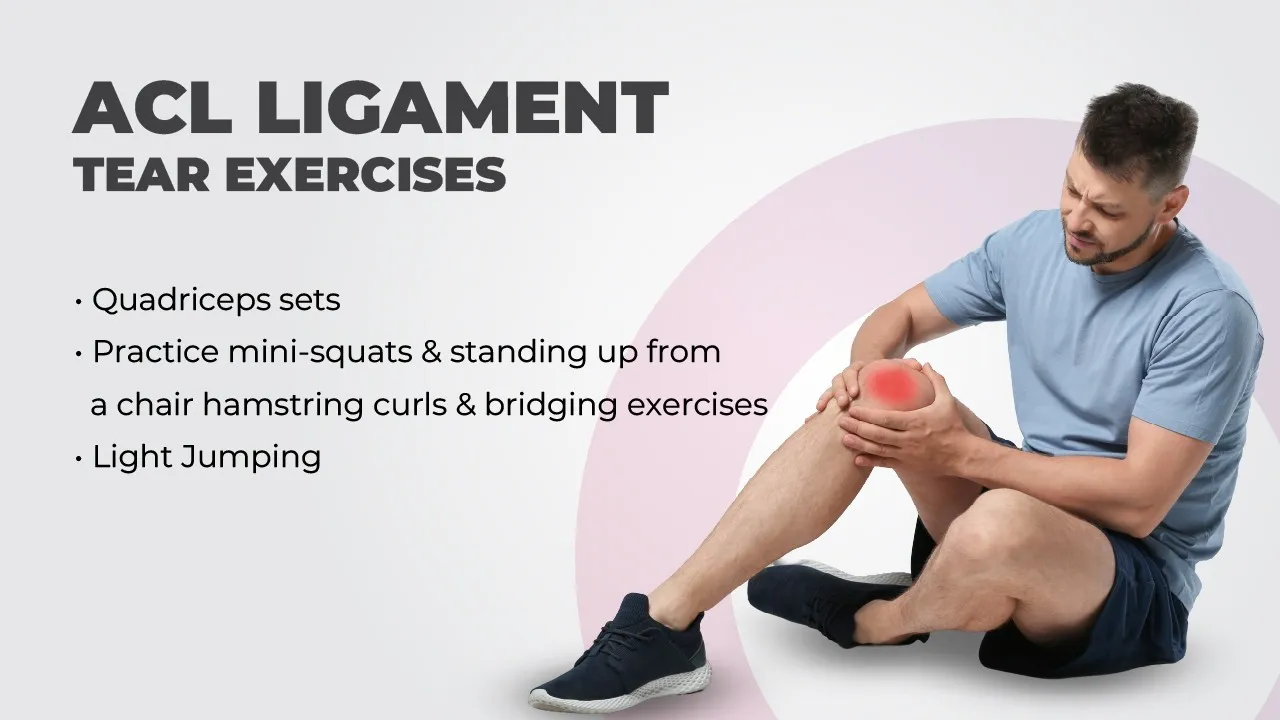
A torn ACL (anterior cruciate ligament) changes how your knee feels and works. It can happen during sport, a slip, or a sudden twist. ACL tears are very common. Recent studies show an incidence of around 68.6 per 100,000 person-years, with most cases in teens and young adults. Therefore, early, structured rehabilitation to fix a torn ACL becomes important. Modern rehab emphasises early safe movement, progressive strength work and balance training. These steps shorten recovery, protect the graft after surgery and improve return-to-sport outcomes. Keep reading to learn more about ACL ligament tears and the right ACL injury rehabilitation exercises for quick recovery.
What Is an ACL Tear and Why Does Rehab Matter?
The ACL stabilizes your knee during sudden changes like cutting, pivoting and stops. When it tears, the knee can feel unstable. If you leave it weak or stiff, the muscles around the knee lose strength. This further raises the risk of re-injury and problems later. In most cases, surgery is required to fix the tear, but most people can also recover with a combination of proper rest, targeted exercise, and physical activity. This is where rehab restores range of motion, rebuilds muscle, improves balance and teaches safe movement patterns.
What Are the Best ACL Ligament Tear Exercises?
Though regaining the strength and stability of your knee will be difficult after the ACL ligament tear, a proper exercise plan can help immensely. If you are keen to regain your mobility and confidence, especially after the ACL reconstruction surgery, you absolutely need to start the following exercises after ACL ligament tear:
Early Phase (0-14 Days) to Regain Motion and Reduce Swelling
At the start, work on gentle motion and control first. This helps prevent stiffness and keeps your muscles active. You can begin with the following ACL injury rehabilitation exercise:
- Heel slides to restore knee flexion. To do this, lie on your back and slowly slide your heel toward your buttock. You can repeat several times a day, as per your convenience.
- Prone or seated knee hangs to regain full extension. Let the knee straighten over a rolled towel or the edge of a chair. Hold briefly and relax.
- Quadriceps sets. Tighten the front thigh muscle and hold for five seconds, then relax. Do many small repeats.
- Ankle pumps and short walks to limit blood clots and improve circulation.
- Stand with both feet, then practice gentle weight shifts. Keep your hands near a support at first.
These exercises aim to make pain manageable and motion normal. Work often, but do not push through sharp pain. Your therapist will check wound healing, swelling, and gait.
Strength And Control (Weeks 2–8) To Build Muscle and Walking Confidence
Once you regain motion and swelling reduces, add strength and normal walking patterns. Your ACL tear recovery physiotherapy will include the following:
- Start with straight-leg raises. Lie down on your back and raise one leg while keeping your knee straight. This also helps stimulate the anterior thigh muscle without straining the knee.
- Practice mini-squats and standing up from a chair. Move slowly and do not bend too deep. Keep your knee pointing forward, not falling inward.
- Use a low step for step-up exercises. Step up and down carefully. Focus on control rather than speed.
- Add hamstring curls and bridging exercises to strengthen the back of your thigh and hips. These muscles protect your knee and improve balance.
- Begin balance exercises by standing on one leg. Hold onto a chair or wall at first. As you improve, try without support for short periods.
- Use a stationary exercise cycle with very light resistance. You can do this exercise for 5-10 minutes and then progress very slowly. Exercise on a cycle develops knee movements and endurance.
This phase shifts you from protecting the knee to actively rebuilding strength and control. Your physiotherapist will monitor technique and pain.
Also Read: ACL Reconstruction
Advanced Strengthening (Months 2–4) For Load And Coordination
Now add heavier resistance and more dynamic control. The aim is a resilient knee that accepts higher forces. You can do the following post ACL surgery rehabilitation exercises:
Begin With Lunges and Squats
Take a shoulder-width stance. Kneel and bend your hips like you're sitting back in a chair. Make sure your chest is straight and your knees are looking forward. For lunges, move one foot forward and lower your body slowly. You should only add weights after you are able to do these without pain or stumbling.
Single-Leg Squats or Bulgarian Split Squats
They are good ways to get stronger in one leg at a time. Stand on the injured leg for a single-leg squat, bend a little, and keep your balance. When you do Bulgarian split squats, one foot should be on the floor and the other should be on a chair behind you. Slowly lower your body, and then use your front leg to push yourself back up.
Strengthen Your Hamstrings
You can do hamstring curls by bending your knee while standing or sitting down with light weights or resistance bands. When doing Nordic hamstring movements, you lean forward slowly from your knees while someone else holds your ankles. You should only do these things with help and a lot of care.
Light Jumping
Start with some light jumping movements, like stepping off a low box and landing with both feet or hopping small distances. When you land, pay attention to doing it gently, bending your knees a little, and keeping them straight instead of going inward. Begin at a low height and move slowly.
Agility Routine
Add some agility routines once your therapist approves them. Begin with straight-line walking or slow running. Move on to make small, slow changes in direction and side steps. Don't make quick turns or sudden twists; instead, keep your actions steady.
Sport-Specific and Return to Running (Months 4–9) For Function And Testing
Returning to run and sports requires specific drills and objective tests. Your physiotherapy might suggest the following ACL tear recovery physiotherapy plan:
- You can begin running between 4 and 5 months, depending on your recovery. Start slowly by walking, then move to light jogging.
- As your knee becomes stronger, your physiotherapist will progress you to sport-related movement patterns. This may include turning, changing direction, kicking the ball, or sudden stopping.
- You will also do jumping and landing exercises. These help train your knee to absorb impact safely. The focus is on landing softly and keeping the knee straight, not collapsing inward.
- Before full return to sport, your therapist will check your progress using simple tests. Your injured leg should be almost as strong as the other one, usually about 90% or more.
- Many people start sports training around 6–9 months if they meet clinical and functional goals. Some take longer. Follow clear milestones rather than an arbitrary date.
How Long Does It Take to Recover from an ACL Ligament Tear?
ACL ligament tear recovery timeline varies with individuals and the extent of the tear. Many people return to daily activities in weeks. Regaining sports fitness can take six to twelve months. NHS guidance notes that most activities resume in months, while sports return may take up to a year. Decisions depend on your age, graft type, if you had reconstruction, muscle strength, and functional test results. Rely on milestones rather than the calendar alone.
Get A Personalised ACL Ligament Tear Exercise Plan from Experts!
ACL ligament tear might start with the pain that feels overwhelming, but the correct workout plan, only after expert consultation, can strengthen the ligament. In these exercises, the ultimate aim is to stabilize the knee so that you can resume your favorite activities.
Contact your clinician if you have increasing pain, new instability, fever or wound issues after surgery. For a complete and active recovery with the plan for ACL injury rehabilitation exercises, connect with experienced orthopedics at Apollo Spectra today.
Recent Blogs

Get Expert Health Advice
Related Blogs


NOTICE BOARD
CONTACT US
FOR PARTNERSHIP
CONTACT US
FOR PARTNERSHIP
.svg)
.svg)
.svg)
.svg)


 Book Appointment


Need Help?
Request a Callback
Have questions about your treatment or consultation? Our experts are here to help.