

I-Pill Side Effects on Future Pregnancy
June 22, 2026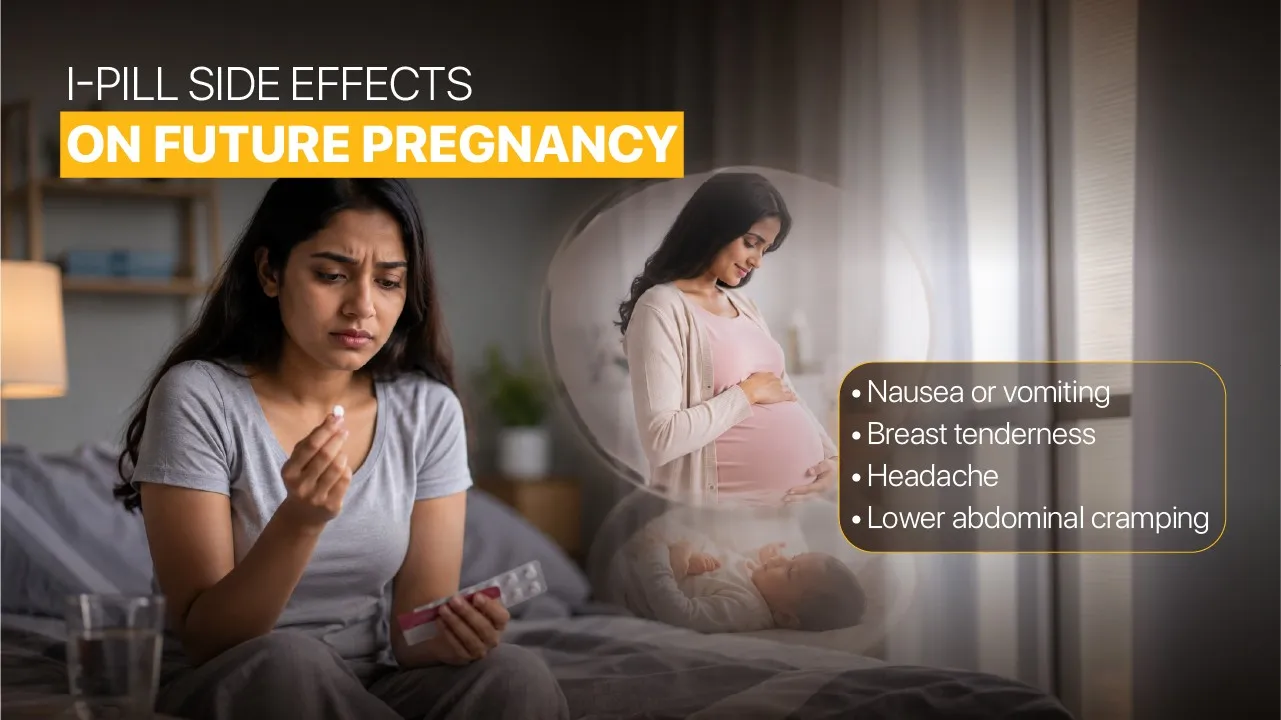
I-pill is an emergency contraceptive pill that contains levonorgestrel (a synthetic hormone that works by delaying ovulation to prevent pregnancy). It is meant to be taken once after unprotected sex. It is not an abortion pill, and it does not harm your reproductive health for the future. So if you have taken an I-pill and are now worrying about whether it will affect your chances of getting pregnant later, here is the direct answer: it will not. Read on for clear answers to the questions most women have after taking it.
Does I-Pill Affect Fertility Permanently?
No. Not even close.
Does I-pill affect fertility permanently is the biggest fear that comes up after taking it, and the evidence on this is completely clear. I-pill works only within the menstrual cycle you take it in. It delays the release of an egg, and once the hormone has cleared your system, usually within 2 to 3 days, your reproductive system carries on exactly as before.
It does not:
- Affect your ovarian reserve (the total number of eggs your ovaries contain).
- Damage to your fallopian tubes or uterus.
- Change your hormonal baseline going forward.
- Reduce your chances of conceiving in any future cycle.
Women who have taken I-pill go on to conceive without any complications linked to prior use. The WHO confirms that levonorgestrel emergency contraception has no documented long-term impact on fertility.
Emergency Contraceptive Pill and Ovulation Disruption
I-pill just pauses ovulation for a temporary duration. Nothing more. Emergency contraceptive pill and ovulation disruption are explained through one specific mechanism:
- Levonorgestrel suppresses the LH surge (the luteinizing hormone signal that tells your ovary to release an egg).
- No surge means no egg. No egg means no pregnancy.
- The pill also thickens cervical mucus to make it harder for sperm to travel, even if ovulation has already occurred by the time you take it.
What it does not do:
- It does not flush out a fertilised egg.
- It does not interfere with an existing pregnancy.
- It does not affect the next cycle's ovulation in any way.
The effect stays entirely within that one cycle and goes no further.
Also Read: Diet during First Pregnancy
What Does I-Pill Do to Your Menstrual Cycle?
Your next period after taking I-pill might look a little different. That is completely normal. Here is specifically what to expect:
| What May Change | Why It Happens | When It Resolves |
|---|---|---|
| Period comes early or late | Hormonal disruption during that cycle | Back to normal next month |
| Spotting or Light Bleeding | Temporary shift in uterine lining | Resolves within a few days |
| Heavier or Lighter Than Usual Flow | Hormonal fluctuation from the dose | Normalises within 1 to 2 cycles |
| Missed or Very Delayed Period | High-dose hormone delay | Take a pregnancy test if over a week late |
Important note: if your period is more than a week late after taking I-pill, do a pregnancy test. The pill is not 100% effective, and a delayed period sometimes signals it did not work.
The I-pill effect on menstrual cycle and conception in future cycles is zero. Your fertility returns in full as soon as that disrupted cycle completes.
What Is the Morning-After Pill Risk of Ectopic Pregnancy?
Morning after pill risk of ectopic pregnancy is real, but not in the way most people assume. I-pill does not cause ectopic pregnancy (a pregnancy that develops in the fallopian tube instead of the uterus). What it means is: if the pill fails and a pregnancy does occur, it carries a slightly higher relative chance of being ectopic. This is because levonorgestrel is better at preventing uterine pregnancies than tubal ones.
See a Doctor Immediately If You Notice
- Sudden, sharp, one-sided pain in the lower abdomen.
- Unusual or heavy vaginal bleeding after the pill.
- Shoulder tip pain, dizziness, or fainting.
These can be early signs of an ectopic pregnancy, which needs same-day medical attention. Do not manage these at home or wait to see if they pass.
Does Levonorgestrel Have Long-Term Effects on the Uterine Lining?
Short answer: no, not from a single emergency contraceptive dose.
The worry around levonorgestrel long-term effects on uterine lining usually comes from mixing up two very different things. The I-pill is a one-time dose. A hormonal intrauterine device (IUD) is a device that releases levonorgestrel continuously over years. These are not the same, and their effects on the body are not comparable.
A single I-pill dose causes a temporary shift in the uterine lining within that cycle. This produces the spotting or irregular flow some women notice. The lining rebuilds itself fully in the next cycle, as it always does. There is no permanent change, and there is no impact on the ability of a fertilised egg to implant in future pregnancies.
Can You Get Pregnant After Taking I-Pill Multiple Times?
Yes, completely. Repeated use of the I-pill does not reduce your chances of conceiving. Each dose clears your body within days, and fertility returns with the very next cycle, every time. Where repeated use does cause a problem is not fertility, but cycle regularity.
What Repeated Use Actually Does
- Cycles become unpredictable and harder to track over time.
- Spotting between periods becomes more frequent.
- I-pill is far less reliable as a contraceptive method. Its effectiveness ranges from 58 to 95%, depending on when it is taken, compared to over 99% for regular methods used correctly.
- It offers no protection against sexually transmitted infections.
If you find yourself reaching for I-pill regularly, a conversation with a gynaecologist about a more consistent contraceptive option is worth having. There are methods that work quietly in the background without disrupting your cycle each time.
What Side Effects Should You Expect?
Most side effects are short-lived and settle within 24 to 48 hours:
- Nausea or vomiting. Food before taking the pill reduces this considerably.
- Breast tenderness or mild discomfort.
- Headache or dizziness.
- Mild lower abdominal cramping.
One practical note: if you vomit within two hours of taking I-pill, the dose may not have been fully absorbed. Speak to a doctor about whether you need to take another dose.
Speak to a Specialist For Right Advice at Apollo Spectra Today!
I-pill is not something to carry anxiety about for weeks after taking it. The evidence is clear and consistent: it does not affect your fertility, does not permanently alter your uterine lining, and does not make getting pregnant harder when you are ready.
If your cycle stays irregular for more than two months, or if you have any specific concerns, book a consultation at Apollo Spectra and speak with a gynaecologist who can give you answers based on your health.
Recent Blogs


Get Expert Health Advice
Related Blogs

NOTICE BOARD
CONTACT US
FOR PARTNERSHIP
CONTACT US
FOR PARTNERSHIP
.svg)
.svg)
.svg)
.svg)


 Book Appointment


Need Help?
Request a Callback
Have questions about your treatment or consultation? Our experts are here to help.