

Knee Pain: Symptoms, Causes, Diagnosis & Treatment
July 17, 2026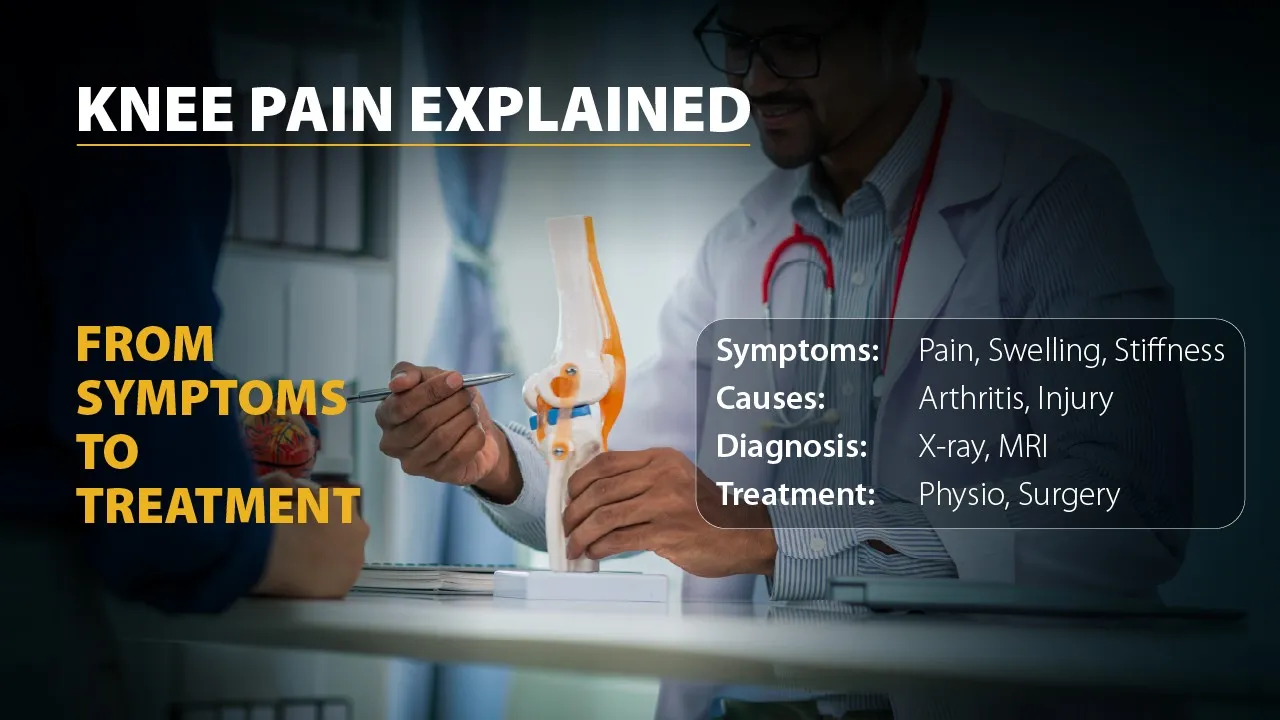
Knee pain is something most people deal with at some point in their lives. It occurs as a sharp twinge after a run, a dull ache that builds slowly over years, or sudden swelling following a bad step. Your knee is a complex joint. It is made of bone, cartilage, ligaments, and tendons. They all work together for a smooth movement. But when any one of them is injured, or worn down, the problem first appears as the pain. Some medical conditions, like arthritis or a mechanical problem within the joint, also cause knee pain. Minor knee pain mostly responds well to home remedies and self-care. Some cases are good to deal with regular physical therapy, whereas complex ones might need surgical repair.
What Are the Common Knee Pain Symptoms?
Pain near the knee region is the most evident sign that you have a problem with your knee. But this pain can also be accompanied by other symptoms that help identify the root cause. In addition to knee pain symptoms, you might experience any of these:
- Swelling and Stiffness. Swelling occurs when excess fluid starts collecting in the joint capsule after an injury. Besides this, people experience stiffness because the fluid, along with inflammation or scar tissue, limits the seamless gliding movement of the joint.
- Redness and Warmth to the Touch. When the knee is inflamed, the body will send more blood to the area so as to help heal the injury. This increased blood flow makes the skin look red and feel warm.
- Weakness or Instability. The knee may buckle unexpectedly or feel unable to bear your body weight. This usually indicates an issue with the ligaments or the muscles that support the joint.
- Popping or Crunching Noises. A clicking or grinding feeling during movement, called crepitus, can mean cartilage damage or other changes inside the joint. It is not always painful, but it should not be ignored if it is new or worsening.
- Inability to Fully Straighten the Knee. Not being able to straighten the leg all the way can be a sign of a torn meniscus, considerable joint swelling, or some other internal structure problem.
What Causes Knee Pain?
Knee pain causes are broadly grouped into injuries, mechanical problems, and arthritis. Sometimes several factors overlap.
Injuries
- ACL injury: The anterior cruciate ligament (ACL) connects your thighbone to your shinbone. It usually ruptures in sports that require sudden acceleration and deceleration, such as those which you might play at school, like football, basketball or tennis.
- Fractures: The kneecap (patella) and surrounding bones can crack from falls or injury. All it takes is one misstep for an osteoporosis patient to suffer a fracture.
- Torn Meniscus: The meniscus is a rubbery, C-shaped cartilage that provides a cushion between the thighbone and shinbone. The knee can also be torn from twisting the weight-bearing leg suddenly, as in sports.
- Knee bursitis: The joint is cushioned with tiny sacs of fluid called bursae, which are designed to help tendons glide smoothly. Repeated pressure or overuse causes them to inflame, which causes localised pain and swelling.
- Patellar tendinitis: The patellar tendon connects the kneecap to your shinbone. It allows you to kick, run and jump. Overuse irritates and inflames it. This is most often seen in runners, cyclists, and athletes involved in jumping sports.
Mechanical Problems
- Loose body: A fragment of bone or cartilage can break away and float freely within the joint. If it drifts into the wrong position, it can suddenly lock the knee mid-movement — like a pencil jammed in a hinge.
- Iliotibial band syndrome: The iliotibial band runs from the outer hip to the outer knee. When it becomes too tight, it rubs against the outer thighbone with each stride. Distance runners are particularly susceptible.
- Dislocated kneecap: The patella can slip out of its groove, usually to the outer side of the knee, causing immediate pain and sometimes a visible deformity.
- Hip or foot pain: Pain originating in the hip or foot quietly alters the way you walk. That shifted gait places uneven stress on the knee joint, producing secondary knee pain even though the original problem lies elsewhere.
Also Read: 5 Best ways to treat Knee Pain
Types of Arthritis
- Osteoarthritis. Sometimes called degenerative arthritis, osteoarthritis is the most common type. It is a wear-and-tear condition that occurs when the cartilage in your knee deteriorates with use and age.
- Rheumatoid Arthritis. An autoimmune condition in which the immune system attacks the joint lining, rheumatoid arthritis can affect almost any joint in the body, including your knees. It is a chronic condition, but people experience it in varied severity.
- Gout. This type of arthritis occurs when uric acid crystals build up in the joint fluid. Gout most commonly affects the big toe but can also occur in the knee.
- Pseudogout. This type is mistaken for gout. Pseudogout is caused by calcium pyrophosphate crystals that develop in the joint fluid. The knee is actually the most common joint affected by pseudogout.
- Septic Arthritis. Your knee joint can sometimes become infected, leading to rapid swelling, pain, and redness. Septic arthritis often comes with a fever and can quickly cause extensive damage to the knee cartilage.
Who Is Most at Risk for Knee Pain?
Knee pain does not target one type of person. You can have severe knee pain if you fall into any of these groups;
- Excess body weight
- Quadriceps and hamstrings that are weak/inflexible
- Poor hip strength and stability
- Jobs or sports that are intense or high-risk
- Repetitive kneeling or crouching
- Sudden spikes in training volume
- Previous knee injury or surgery
- Ageing and senescence of cartilage
- Osteoporosis or low bone density
Can Knee Pain Be Prevented?
Not every injury or pain is avoidable, but certain lifestyle changes and daily habits help you manage even the complex problems with less pain. Here’s what you can do to prevent knee pain:
- Maintain a healthy body weight
- Strengthen the quadriceps, hamstrings, and hip muscles
- Warm up properly before physical activity
- Increase training load gradually, not suddenly
- Stretch regularly to maintain muscle flexibility
- Wear appropriate, well-fitted footwear for your activity
- Replace worn-out shoes before they alter your gait
- Avoid prolonged kneeling without knee protection
- Allow adequate recovery time between intense sessions
How Is Knee Pain Diagnosed?
When you visit the clinic, your orthpedics starts with a physical examination. They will inspect your knee for any swelling, tenderness, visible bruising, range of motion, and joint stability. In some cases, knee pain diagnosis may also involve imaging tests, such as:
- An X-ray to check for fractures and bone changes.
- An MRI for detailed images of soft tissues, alongside ligaments, tendons, and cartilage.
- Ultrasound to check tendons and bursae in real time.
If infection or inflammatory arthritis is suspected, your doctor will also suggest blood tests and analysis of the fluid inside the joint to give clearer answers.
What Are the Available Knee Pain Treatment Options?
The most effective knee pain treatment plan is created by first identifying the root cause behind it. Your doctor also checks how far the condition has progressed. And based on the severity of pain, this is what you can expect:
- Medication. For mild to moderate cases, NSAIDs (such as Ibuprofen) are administered for pain relief and inflammation.
- Physical Therapy. Your doctor will recommend a few exercises that you perform to strengthen the muscles around the joint and retrain movement patterns that are contributing to pain.
- Injections. In osteoarthritis, bursitis, gout or rheumatoid arthritis, your doctor might also recommend corticosteroids or hyaluronic acid injections for pain relief.
- Surgery. For cases where the structural damage is unresponsive to conservative care, one of the following surgeries is recommended:
- Arthroscopy: A thin tube with a camera goes in through small cuts to fix torn cartilage or clean out damaged tissue. Most patients walk the same day and return to daily activities within 2 to 6 weeks, though this varies by procedure and patient.
- Partial knee replacement: Only the damaged part of the knee is replaced with an artificial surface. Healthy bone stays untouched. Hospital stay is usually 1 to 2 days, with recovery in 4 to 6 weeks.
- Total knee replacement: The whole joint is replaced with an artificial one. Used when damage covers most of the knee. Hospital stay is usually 2 to 3 days, with full recovery taking 3 to 6 months.
How to Reduce Knee Pain at Home?
For mild symptoms, you can use the RICE method. In this, you should do the following:
- R - Rest the joint
- I - Apply ice for 15 to 20 minutes several times a day
- C - Use a compression bandage for gentle support
- E - Elevate the leg while resting
If the pain is mild, you can even get over-the-counter (OTC) anti-inflammatory medicines like ibuprofen. Sometimes, low-impact activities like swimming or cycling keep the joint moving without overloading it. And this turns out way better than complete rest.
When To See a Doctor for Knee Pain?
Home care works well for minor symptoms, but certain signs mean the knee needs professional attention sooner. Call your doctor if you:
- Cannot put weight on your knee or feel as if it gives out
- Have significant or rapidly worsening swelling
- Are unable to fully extend or bend your knee
- Notice an obvious change in the shape or alignment of the knee
- Have a fever alongside redness, pain, and swelling in your knee
- Have severe knee pain that followed an injury
- Have pain that does not improve with rest and home care within a few days
Conclusion
Whether the cause is a sports injury, gradual joint wear, or a chronic condition like arthritis, an accurate diagnosis points the way to the right treatment. Managing your weight, building strength in the muscles that support the joint, and acting on symptoms all help you in dealing with pain.
If knee pain is affecting how you move, sleep, or get through your day, speak with a specialist at Apollo Spectra. The earlier the cause is identified; the more options remain open to you.
Recent Blogs
Get Expert Health Advice
Related Blogs

NOTICE BOARD
CONTACT US
FOR PARTNERSHIP
CONTACT US
FOR PARTNERSHIP
.svg)
.svg)
.svg)
.svg)


 Book Appointment


Need Help?
Request a Callback
Have questions about your treatment or consultation? Our experts are here to help.